
Wat Pha Lat is worth visiting if you give it sixty to ninety minutes on site, arrive outside the September flash-flood window, and understand you are looking at the second stage of a three-temple sequence up Doi Suthep, not a fifteen-minute photo stop. The temple itself stays free, but since 1 October 2025 the Doi Suthep-Pui National Park charges 100 baht for foreigners who enter through the Monk’s Trail nature-trail gate, while visitors arriving by the paved road 1004 pay nothing.
The reason this matters is that almost every English travel guide still frames Pha Lat as a “hidden jungle gem” discovered around 2018. It isn’t hidden, and it isn’t untouched: the white hall you see at the stream, Hor Phra Chao Rim Nam, was a pile of rubble in the early 2010s and was rebuilt between 2017 and 2019 by the Fine Arts Department from a single 1898 photograph. Treat the temple as a fifteen-minute detour on the way up to Doi Suthep and you will miss the one thing that makes it distinct from every other temple in the city.
Walk behind that white hall in the dry season and you can see why the building keeps needing repair. It sits directly above the bed of a seasonal stream: in January the watercourse is a line of dry boulders two metres below the terrace, and in late September of 2014, 2024 and 2025 the same channel carried enough water to tear out footbridges and undercut the foundations of the hall itself.
[wptoc]
What Wat Pha Lat Is, and Why It Sits Where It Sits
Wat Pha Lat is the middle temple in a three-temple sequence on the western slope of Doi Suthep, each marking one of the three earthly stages of awakening in Theravada Buddhism. Its formal name, posted on the signboard at the entrance and recorded in the Tambon Suthep local administration documents, is Wat Sakadagami: the Once-Returner, second of the three stages in the Puggala Sutta (AN 9.9). Below it at the foot of the mountain stands Wat Sri Soda, formally Wat Sotapan, the Stream-Enterer. Higher up the slope stands Wat Mon Phaya Hong, formally Wat Anagami, the Non-Returner. Three temples, three stages, one continuous pilgrimage route.
The legend that links them is the white elephant of King Kuena of Lanna, who in the fourteenth century was searching for a place to enshrine a Buddha relic from Sukhothai. The elephant climbed the mountain, stopped three times, and died at the summit, where Kuena founded Wat Phra That Doi Suthep in 1383 to hold the relic. The three stops became the three temples below. This is not a decorative origin story: the name Pha Lat itself comes from the Northern Thai for sloping rock, the stone ledge over which the stream runs on the temple grounds, and the first stop of the elephant was recorded as this ledge rather than a random clearing in the forest.
Understood this way, Wat Pha Lat stops being a random hidden temple and becomes a specific point on a deliberate spiritual geography. Every element a visitor sees on the terrace, the naga staircase, the chedi, the white hall above the stream, the rabbit and peacock on the roof, sits inside this frame. Remove the frame and the temple flattens into atmosphere. Keep it, and the rest of the article is about which details carry the meaning and which ones are ornament.
Is Wat Pha Lat Worth Visiting?
Wat Pha Lat is worth visiting if you want to understand one specific temple in depth, and not worth visiting if you treat it as a check-in stop on the way to Doi Suthep. The dividing line is time on site. Sixty to ninety minutes is the minimum to walk the terrace, see Hor Phra Chao Rim Nam at the stream, find the rabbit on the roof, reach the chedi, and hear the monastery operating around you. Fifteen minutes gives you the Instagram photograph and nothing else, and the people who come away saying Pha Lat is “overrated” or “just another temple” are almost always the people who spent fifteen minutes.
The “hidden” label also deserves a correction. By the materials collected by local historians, Wat Pha Lat was a documented stop on royal visits to Doi Suthep at least from 1898, when Prince Damrong Rajanubhab passed through on the trip whose surviving photograph would later guide the 2017 restoration. King Prajadhipok (Rama VII), Queen Ramphaiphanni and Princess Dara Rasami are recorded as visiting in January 1927, the visit documented in a four-hour silent film. The period of relative obscurity was roughly the 1940s to the 2010s, not the temple’s whole history. What the English guides call a discovery around 2018 is in practical terms a return to visibility after seventy quiet years, which is a very different story from a secret jungle temple uncovered by bloggers.
Who should come: anyone interested in how Burmese-Mon aesthetics entered Lanna temples, anyone planning to climb Doi Suthep and willing to budget an extra hour on the way up or down, and anyone who wants a working monastery rather than a cleaned-up attraction.
Who should skip it: travellers already pressed for time in Chiang Mai, people looking for shops and food on site, and anyone unwilling to cover shoulders and knees at the gate. Specific questions on the park fee, solo hiking, hiking with children, and guided tours are answered in the FAQ at the end of this article.
How to Get to Wat Pha Lat: Four Approaches Compared
There are four practical ways to reach Wat Pha Lat from central Chiang Mai, and the choice now has a real cost attached to it.
In plain order: walk up the Monk’s Trail, ride a scooter up road 1004, take a Grab or metered taxi, or catch a red songthaew to the trailhead or directly to the temple gate.
Approximate distance from Tha Phae Gate in the Old City is 6.5 kilometres by road and roughly 4.5 kilometres walking via the trail; the road climbs to the temple car park in about twenty minutes by scooter in light traffic.
Monk’s Trail on foot is the option most travellers plan for, and the one most affected by the October 2025 change. The trail starts at the end of Suthep Road, past Chiang Mai University and the Chiang Mai Zoo, with the Army Radio and Television Channel Station and the DCondo Campus Resort as the most reliable landmarks at the trailhead. From there it is free entry until about 8:00 in the morning, when the Doi Suthep-Pui National Park fee collection typically starts at the nature-trail gate, at which point foreigners pay 100 baht, foreign children 50, Thai adults 20 and Thai children 10. The walking segment to Pha Lat is the easy half of the trail: thirty to fifty minutes, roughly 160 metres of vertical gain, orange strips of monk’s robe tied to trees as waymarks.
Scooter up road 1004 is the cleanest option for visitors who already have a rental, because the paved road approach is not charged by the park. The turnoff and small car park sit below the temple on the uphill side of road 1004, between Chiang Mai Zoo and the summit temple, clearly signed in Thai and English. Parking at the temple itself is limited but workable outside weekends. Grab and metered taxis use the same road and can drop you at the gate, but return transport is the actual problem: Grab availability on the mountain drops sharply after 15:00, and standing at the gate waiting for a car with no signal is a known failure mode. If you take a Grab up, either negotiate a wait or pre-book a return time. Red songthaews running toward Doi Suthep from the university side pass the temple entrance and can drop you there for a negotiated fare, usually between 60 and 100 baht one way per person depending on load; return songthaews do not run on a fixed schedule and fill up faster as the afternoon moves on.
The matrix most travellers need: if you already have a scooter and do not want to pay, take road 1004. If you do not have a scooter, use a scooter rental for flexibility and access via road 1004. If you want the walking experience and cost is critical, start the Monk’s Trail before 8:00 in the morning. If you want the trail and do not care about 100 baht, start after 8:00 with the fee paid at the gate. If you have small children or it is burning season, use Grab up and a pre-arranged return.
Monk’s Trail to Wat Pha Lat: Trailhead, Time, Difficulty
The Monk’s Trail begins at the uphill end of Suthep Road, where the asphalt runs out beside the Army Radio and Television Channel Station and the DCondo Campus Resort apartment block, and takes thirty to fifty minutes to reach Wat Pha Lat. The first half of the trail, the section most travellers actually walk, covers about 1.5 to 2 kilometres with roughly 160 metres of elevation gain. Surface is packed earth and tree roots, shaded under canopy for most of the way, with the orange strips of saffron cloth tied around trunks as waymarks; this is the visual signal the trail is named for, and it genuinely works as navigation in place of maps.
Difficulty is moderate but not demanding: comparable to a steady twenty-storey stair climb in warm weather, nothing technical. Closed shoes are non-negotiable because of exposed roots and loose stones on the steeper pitches, and because the same trail is used in sandals by visitors who then leave it for the road because their feet cannot cope. The trail is broadly safe to hike alone during the main daylight hours; the known risks are loose dogs at the trailhead (the monastery and neighbouring houses keep resident dogs, usually calm, occasionally territorial in small packs), late-afternoon visibility on the return if you started too late, and the heat between 11:00 and 14:00 when the upper pitches are in sun. Snake encounters are uncommon and almost always non-venomous ground snakes on the path margins; the relevant precaution is simply to watch your step near logs and stone.
The upper segment, from Wat Pha Lat up to Doi Suthep, is a different trail in practice and is covered in the Pha Lat vs Doi Suthep section below. Most visitors turn around at Pha Lat, take Grab or songthaew down, or drive back up 1004 to the summit. This is the correct default. Before committing to that default, it is worth knowing exactly what the gate schedule looks like and when the park fee applies in practice, which is the subject of the next section.
Wat Pha Lat Opening Hours and Entrance Fee
Wat Pha Lat is open every day from 6:00 to 18:00, and the temple itself has no entrance fee; since 1 October 2025 the Monk’s Trail nature-trail entry costs 100 baht for foreign adults, 50 for foreign children, 20 for Thai adults and 10 for Thai children, while visitors arriving by the paved road 1004 pay nothing. The fee is collected by Doi Suthep-Pui National Park at the gate on the forest side, together with the neighbouring Huai Kaew Waterfall, Wang Bua Ban, Doi Pui and Suan Son zones, as part of the same October 2025 reform. It is not a temple donation and not a Wat Pha Lat charge; the temple continues to operate on voluntary donations at the shrines.
The 6:00 to 18:00 window reflects the practical rhythm of an active monastery rather than a tourist schedule. Early morning chanting starts roughly around 6:30 and lasts about half an hour; this is the quietest and coolest period on the terrace, and the reason many visitors aim for a sunrise-adjacent arrival. After 18:00 the trail is not lit and the monastery closes public access, which is why descending via Monk’s Trail at dusk is a poor idea even if you started early. Shops, kiosks and food stalls are not part of the setup, and expecting them is a common mismatch between guidebook descriptions and what you actually find at the gate.
Two practical notes about the fee. First, before roughly 8:00 in the morning the nature-trail gate collection often does not operate in practice, which means early starters frequently walk the Monk’s Trail without paying; this is not a guarantee but is the pattern reported across 2025. Second, the fee applies to a zone, not a ticket: if you pay at the Monk’s Trail gate you can in principle move between Pha Lat, Huai Kaew Waterfall and the neighbouring park zones on the same day without paying again, provided you keep the slip.
What to Wear and What to Bring
Dress code at Wat Pha Lat is covered shoulders and covered knees for everyone, enforced at the terrace rather than the gate. The temple does not rent sarongs on site, which means turning up in a tank top and shorts means being turned away from the main buildings; a light long-sleeved layer or a wrap in your bag solves the problem and weighs nothing. Closed shoes are the other hard requirement if you plan to walk the Monk’s Trail, both for root-and-stone grip and because the monks themselves walk the trail in simple sandals and do not appreciate tourists treating it like an urban promenade.
What to bring, in plain order: a half-litre to one litre of water per person minimum, mosquito repellent (the stream and shaded canopy make afternoon mosquitoes real), a small cash note for the park fee if you are entering by trail after 8:00, and covering layers. There is a small café on the grounds serving drinks; there is no food, no vending machines, no restaurant, no convenience store between the end of Suthep Road and the temple, and no reliable refill point once you pass the trailhead. Toilets exist on the temple grounds and are maintained to a basic but working standard; bring your own tissue.
Behaviour inside the monastery matters more here than at the bigger, more heavily managed temples in the city because Pha Lat is actively used. Keep voices down. Do not step onto the meditation platforms or into the residential areas behind the main terrace. Do not touch Buddha statues or sit with the soles of your feet pointing toward them. Remove shoes where signs indicate, and follow the monks rather than the other tourists when in doubt. None of this is special treatment; it is the minimum expected at an operating Thai monastery and it is routinely ignored at Pha Lat because travellers arrive from the trail in a “nature walk” mindset rather than a “temple visit” one.
What to See at Wat Pha Lat (and How Long to Stay)
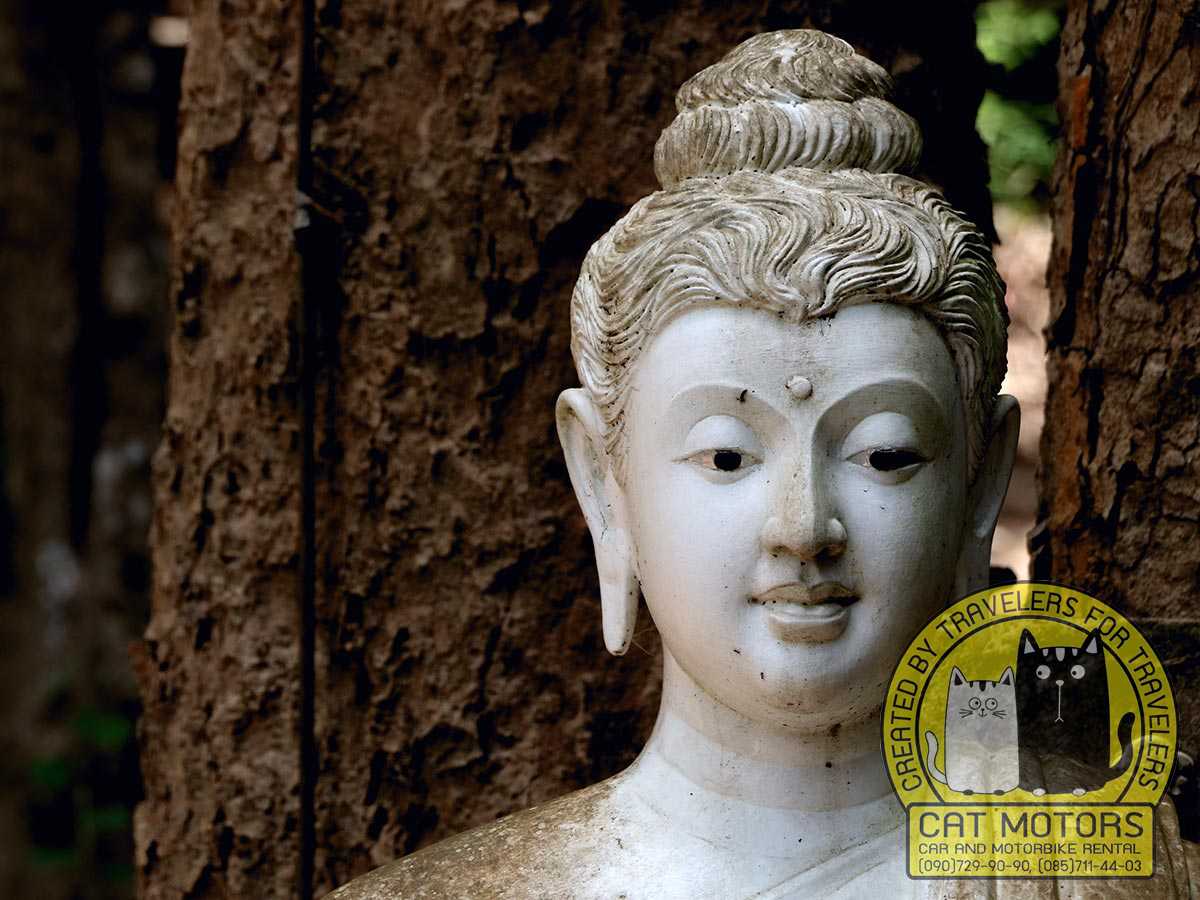
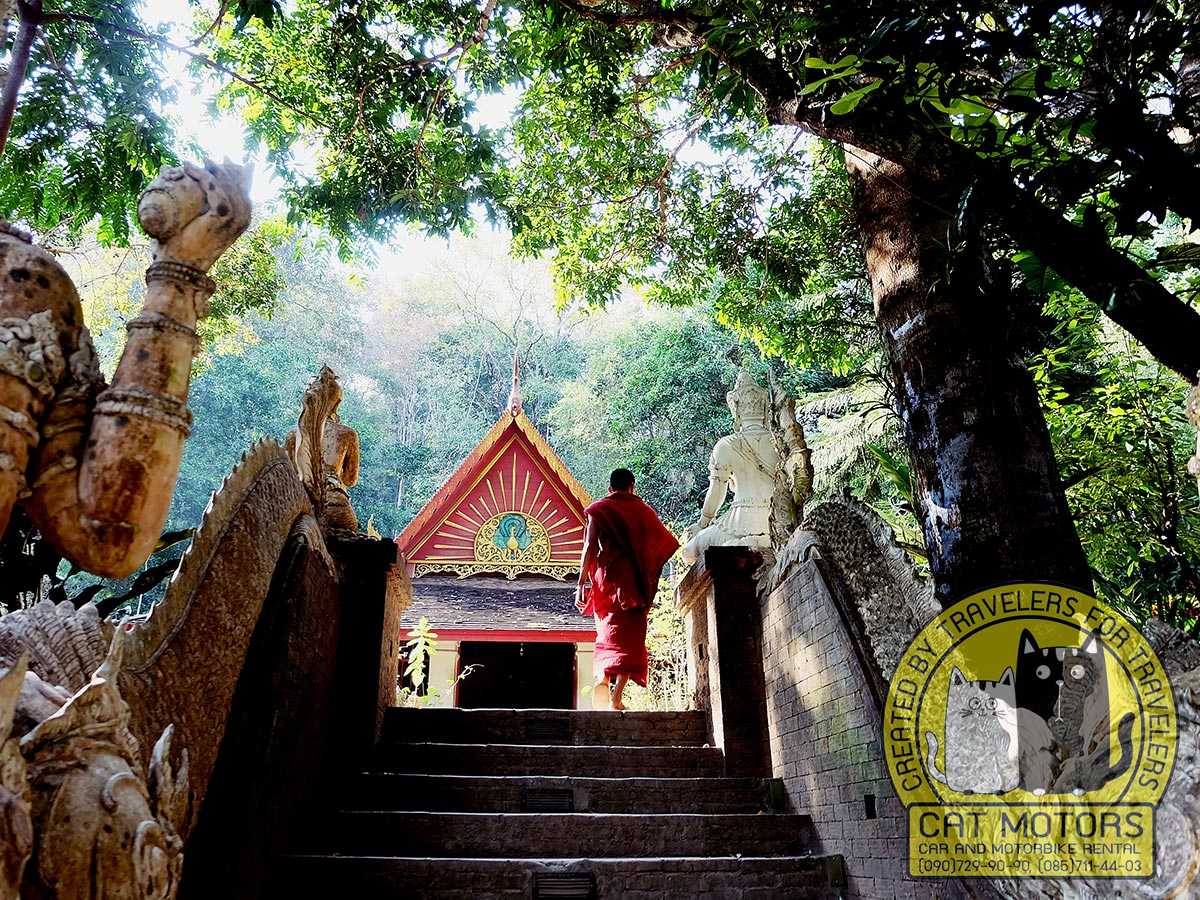
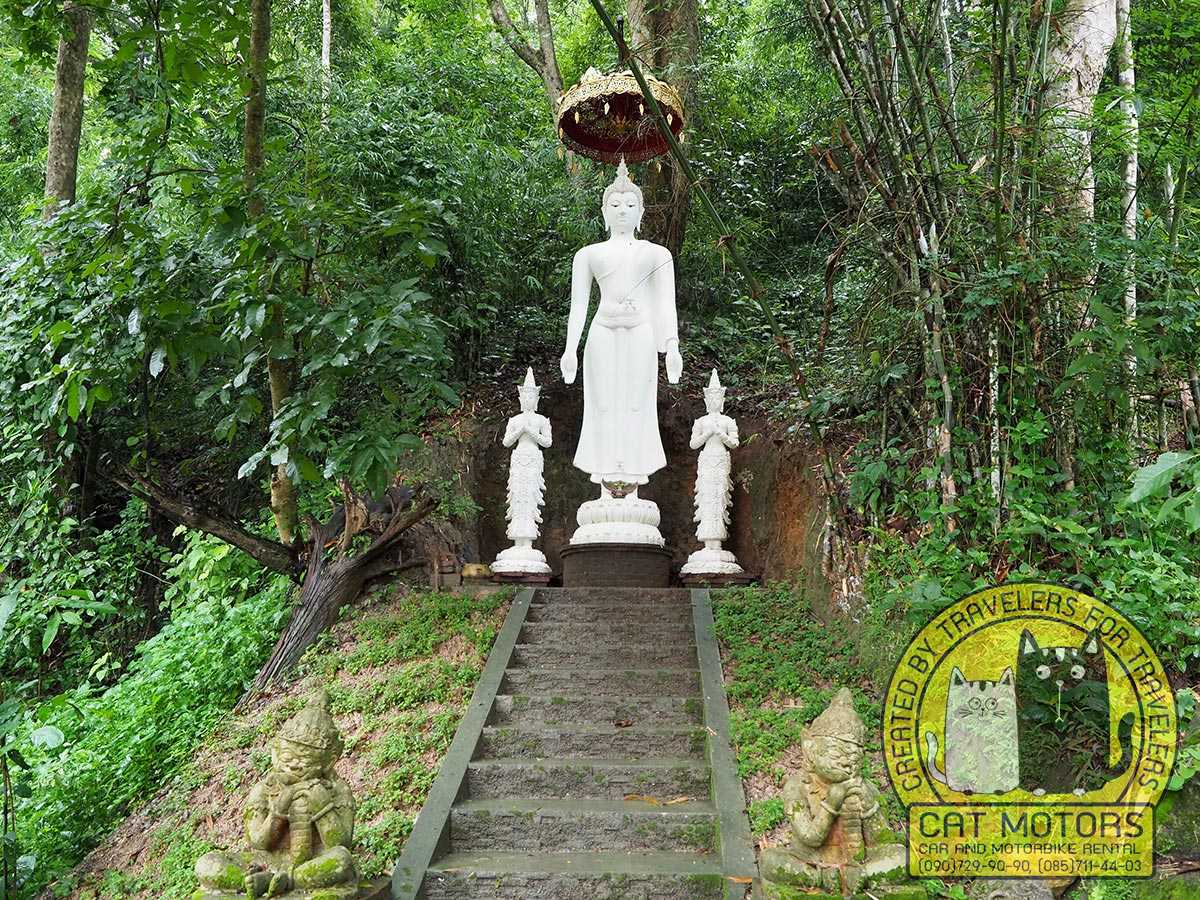
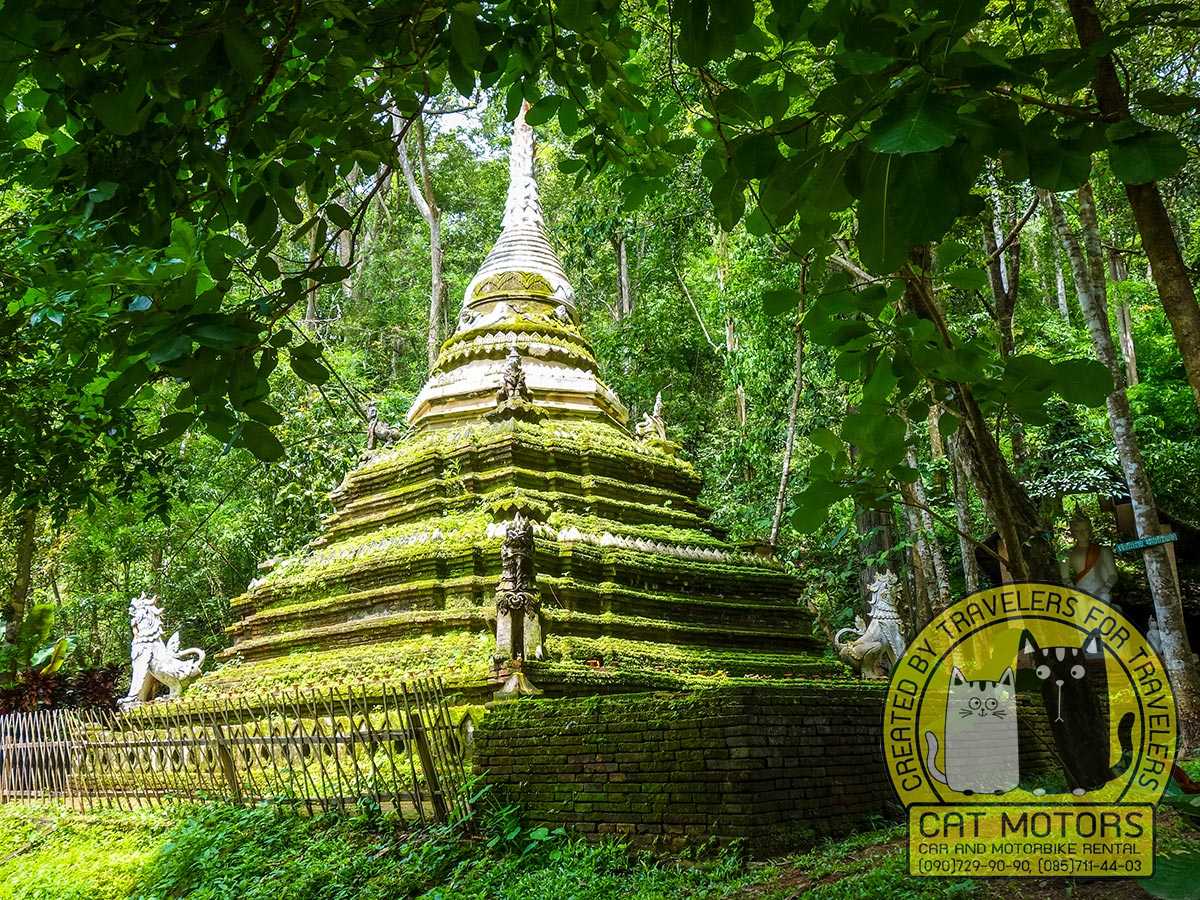
Plan sixty to ninety minutes on the terrace to actually see Wat Pha Lat, and up to two hours if you want to sit with the place. The main things a visitor is looking at, in the order they typically appear on arrival from the Monk’s Trail: the stream and the small cascade over the sloping rock the temple is named for, the white Buddha figure beside the upper approach, the naga staircase climbing from the stream to the main terrace, the ancient chedi at the back of the compound, the main viharn with its multi-tiered roof and carved eaves, and Hor Phra Chao Rim Nam, the white hall standing directly above the watercourse. The elephant carving near the stream marks the white-elephant legend physically rather than symbolically.
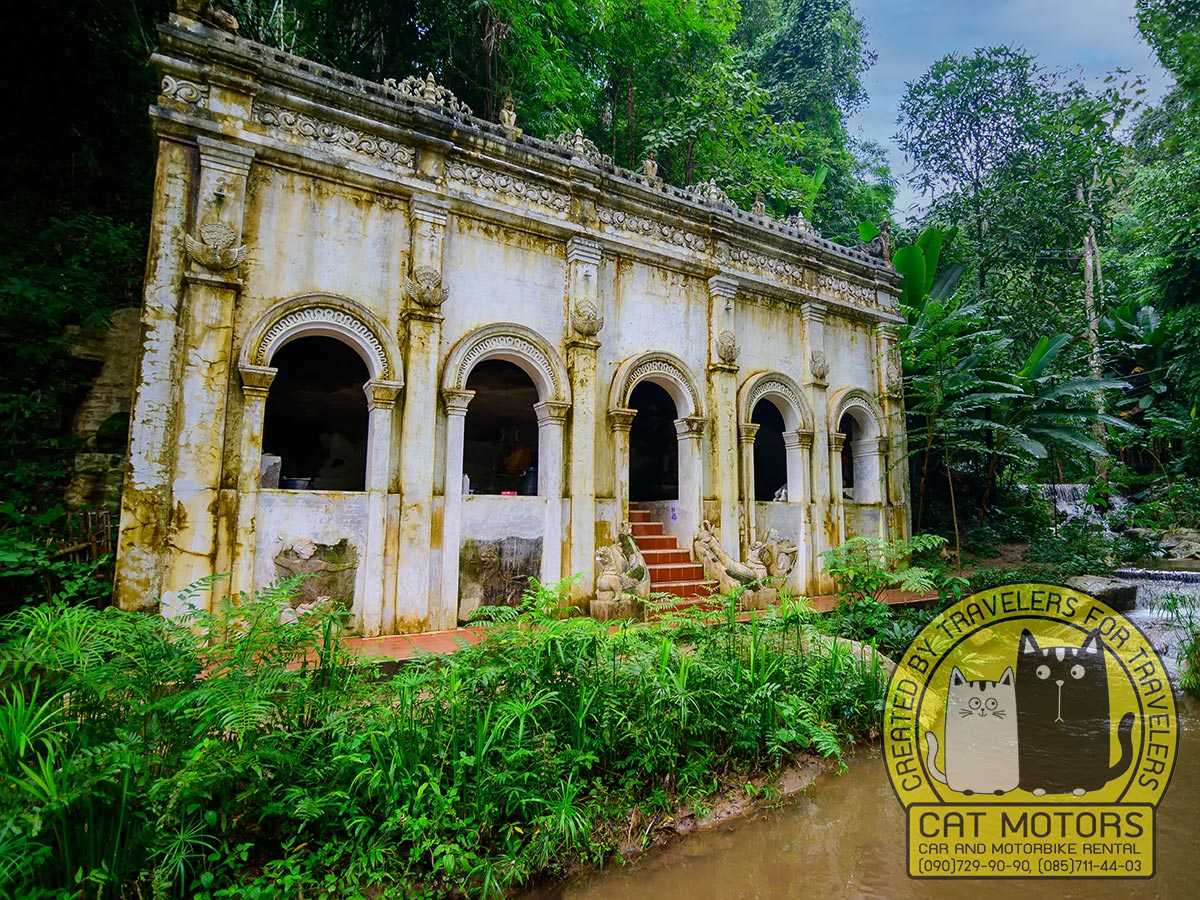
Of the structures on the grounds, the one most distorted by English guides is Hor Phra Chao Rim Nam. Its name translates as “Hall of the Buddha by the Water”. It was built in the late nineteenth century under the last Lanna ruler Kaew Nawarat, with Princess Dara Rasami and Luang Yonakarn Phichit (better known by his Burmese name Mong Panyo) as the figures whose patronage put it there; its Burmese-Mon signature is the multi-tiered roof that carries the peacock and rabbit described in the next paragraph, not the generic “jungle pavilion” look English guides reach for. By the early 2010s the building had collapsed down to its foundations. The abbot of Wat Pha Lat, Phra Maha Sa-ng Theerasangwaro, approached the Fine Arts Department, and restoration was undertaken by the Chiang Mai 7th Regional Office between 2017 and 2019 at a cost of roughly twelve million baht, with the architect-restorer Therdsak Yenjura working from the single surviving photograph, taken during Prince Damrong Rajanubhab’s 1898 visit. The white hall visible today is that reconstruction. Treated this way, it is not a miraculously surviving antique; it is a piece of institutional restoration work built from one photograph, which is arguably more interesting than the miracle version.
The roof of the main viharn carries the detail that separates Pha Lat from its reputation for generic “Burmese influence”. By materials collected by local historians and the documentation in Changpuak Magazine, the two opposite slopes carry two different animals. On one side stands a peacock, the Burmese-Mon symbol of the sun and of royal authority, and in Buddhist iconography associated with the capacity to absorb poisons and continue on the path. On the opposite slope stands a rabbit, the zodiac year-sign of the monk who led the temple during the reconstruction period. This is not a folk-art flourish; it is a personal autograph on the building, identifying a specific person and a specific year. If you look at only one roof detail at Pha Lat, look at the rabbit, because it is the detail that no AI description and no guidebook will tell you is there.
Mong Panyo himself was not a Wat Pha Lat one-off. By materials collected by local historians, he financed restorations at Wat Phra Singh, Wat Chedi Luang, Wat Phra That Doi Suthep, Wat Chedi Liam, Wat Mahawan, Wat Saen Fang and Wat Buppharam, among others. The peacock-and-rabbit roof you just read about, and the Hor Phra Chao Rim Nam it sits above, belong to the same decade of work and the same donor network as the roofs and viharns at those other temples: one patron, one consistent taste, one systematic programme of restoration in Chiang Mai during the first decades of the twentieth century. Pha Lat is not isolated; it is one node in that network.
Best Time to Visit: Day, Season, and the Flash-Flood Window
The best time to visit Wat Pha Lat is early morning between 6:30 and 8:30, in the dry window from November to early January, and the worst is between late August and early October because of the seasonal flash-flood pattern. Early morning gives cooler trail temperatures, softer light on the stream, the chanting window around 6:30, and the practical bonus that the Monk’s Trail fee collection often does not operate before 8:00. Late afternoon from around 16:00 until about 17:30 is the second-best window: fewer visitors, warmer light on the Hor Phra Chao Rim Nam facade, but a harder problem with return transport and a genuine risk of descending the trail near dusk. Midday between 11:00 and 14:00 is the worst daily window in every season: hot, flat light, crowded, and the steep parts of the trail fully exposed.
The seasonal window matters more than most guides admit. November to early January is the peak dry season in northern Thailand: clear air, moderate temperatures, minimal rain, and the stream running at a low, clean level. This is the period the temple itself is in the best physical condition, because September repairs are complete and the next flood season is still ten months away. Mid-January to late February is still acceptable but begins to show the transition; March through early May is burning season, when PM2.5 in the Chiang Mai basin runs at levels that make climbing the trail physically unpleasant and drop visibility from the terrace to a grey haze. The temple is not formally closed, but the reason to visit effectively disappears. Late May through early August is rainy season proper, with soft ground, heavier mosquitoes, and occasional mid-afternoon downpours, but no specific threat to the building.
Late August to early October is the window to actively avoid. Wat Pha Lat stands in the bed of a seasonal stream, and when northern Thailand gets a heavy monsoon burst, the same watercourse that produces the picturesque cascade becomes a flash flood. Three documented episodes, September 2014, September 2024 and September 2025, tore out footbridges and undercut the foundations of Hor Phra Chao Rim Nam; the temple’s own social media posts during the 2024 and 2025 events showed water running through the base of the white hall. After these events the grounds are partially closed, bridges are temporary, and the buildings carry visible damage until repairs are completed, typically by late October or early November. If you arrive in this window you are not seeing the temple at its best, and in years like 2024 and 2025 you are seeing it at its actively worst.
How to Check if Wat Pha Lat Is Closed Before You Go
Wat Pha Lat closes for intensive meditation retreats several times a year, for one to five days at a time, and the dates are published on the temple’s own Facebook page rather than through Google or Maps. The page to check is “Wat Pha Lat – Sakadagami”, and the practical rhythm, by several tour operator notices circulating for the 2025 to 2026 season, is a short closure window in early December (recorded example: 1 to 5 December 2025), a short window around Makha Bucha in February (recorded example: 1 to 2 February 2026), and additional ad hoc retreat periods that appear on shorter notice. These are not annual fixed dates; they are an operating pattern tied to the fact that Pha Lat is an active monastery running public retreats, including those led by Phra Sone, whose programmes appear on international event platforms.
Check the Facebook page one to two days before your intended visit, not a week before. Retreat notices tend to be posted a few days ahead, and the information does not consistently flow through to Google Maps, travel blogs or tour booking platforms, which is why travellers turning up on posted retreat days find the gate closed without warning. If you cannot read Thai, the page carries enough English and enough visible date posts to make the calendar legible with a translation tool. If the page shows no announcement for your dates, you are probably fine, but the default assumption should still be a quick check, not a reflexive assumption of openness.
There is a second layer of verification worth doing on the same day: a quick look at recent reviews and photos from the last week, on Google Maps or in the trail pages on AllTrails. After a September flood episode or an unannounced closure, these tend to show the current ground state faster than any travel guide will. The action item is simple and short: open the temple’s Facebook page, scan the last ten posts for date closures, then open Google Maps reviews from the last seven days to see if anyone has reported actual access problems. Two minutes of checking before leaving the hotel prevents the scenario of arriving at a locked gate after a forty-minute climb.
Wat Pha Lat vs Doi Suthep: Choose or Combine
Wat Pha Lat and Wat Phra That Doi Suthep are different objects serving different purposes: Pha Lat is a middle-slope working monastery built around a stream, a naga staircase, a white hall above the water, an ancient chedi and the peacock-and-rabbit roof, and Doi Suthep is the mountain-top royal stupa containing the Buddha relic that the entire pilgrimage was built around. Combining them works well if you have the time and are interested in walking the three-stage spiritual geography end to end; combining badly, for example a twenty-minute stop at Pha Lat on the way up, produces the flattest possible visit to both. The clean combination is Pha Lat first for sixty to ninety minutes, then Doi Suthep by scooter or songthaew up road 1004, and this pairs naturally with a morning start and a lunch back in town. Skip the combination if you have small children, if it is burning season, or if your schedule forces the Pha Lat visit after 13:00.
Continuing on foot from Wat Pha Lat up to Doi Suthep is the option that generates the most mismatch between guidebook description and reality. The second segment of the trail, from Pha Lat to Doi Suthep via the area of Wat Mon Phaya Hong (formally Wat Anagami, the third of the three stages), takes roughly one to one and a half hours, climbs significantly more than the first segment, and changes character entirely. It is steeper, rockier, less shaded, crosses sections under exposed power lines, and is genuinely hard work in midday heat. It is not a simple extension of the first walk; it is a separate decision that needs its own time budget and its own water supply. Plan it as a morning activity starting from the trailhead by 7:00, or skip it.
The boundary choice in one sentence: if you want to understand the mountain’s spiritual geography, combine; if you want a short visit and one photo, pick one and go to Doi Suthep. Wat Umong, often surfaced as another hidden temple alternative, is a different experience entirely, located on flat ground closer to the university and known for its tunnels rather than its slope or its stream, and is not a direct substitute for either Pha Lat or Doi Suthep.
Stand on the small bridge over the stream near Hor Phra Chao Rim Nam and look at the span underfoot, and then at the next bridge twenty metres upstream. The timbers are different, the concrete abutments are different, the joinery is different. By the Matichon reports on the September 2024 and September 2025 floods and by visitor photos from 2025, at least two of the bridges on the grounds carry visible layers from separate repairs, stacked like the dated rings of a tree.
This is the actual condition of Wat Pha Lat: a second stage in a three-temple sequence, restored building by building by the Fine Arts Department, gated on one side by a new park fee, and periodically half-dismantled by the same stream that makes the photographs. The old-looking parts are old-looking because the monastery keeps making them old again, every time the water comes through.


