January 2026 brought us motorcycles that renters planning trips through northern provinces had been requesting for years.
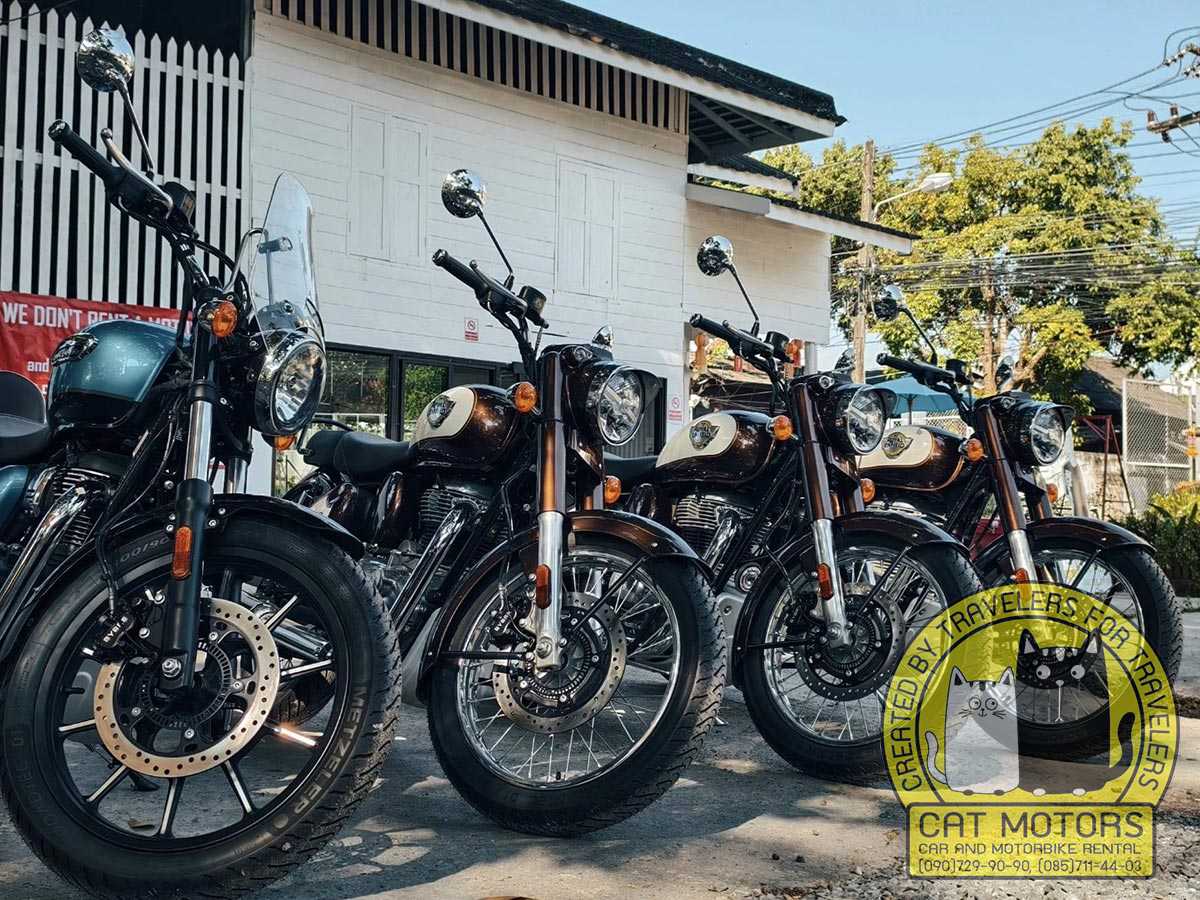
Royal Enfield Classic 350 motorcycles are now available at our motorcycle rental in Chiang Mai, a decision driven not by retro-aesthetic trends but by practical considerations of those who actually ride mountain roads in Thailand.
Contents
show
Northern Thailand demands specific qualities from a motorcycle. There are no highways here, but there are serpentines with gradients up to 12%, where you constantly work the throttle in second or third gear. There are sections like the road to Doi Ang Khang, where asphalt suddenly transforms into packed dirt with fist-sized rocks, then returns to normal pavement. There are prolonged climbs to Phu Chi Fa or Mae Hong Son, where the motorcycle works for hours at mid-range RPMs, crawling from 300 meters above sea level to the 1,500-meter mark. And there are long straight sections between rice fields in the Mae Taeng valley, where you just want to ride without thinking about the next fuel stop.
The Royal Enfield Classic 350 handles this set of requirements better than many other motorcycles in its category. Not because it’s faster or more powerful (it’s neither faster nor more powerful), but because its characteristics precisely match the specifics of northern Thai roads.
Torque Where It Matters
The single-cylinder engine with a displacement of 349 cubic centimeters produces 27 horsepower and 27 newton-meters of torque. Modest figures by modern standards, but what matters isn’t the absolute value but at what RPM this torque is available. The Royal Enfield delivers maximum torque at 4,000 revolutions per minute, precisely in the range where the engine operates most of the time on mountain roads. No need to spin the motor to 8,000 RPM to get pulling power; it’s already there at 3,000-3,500. This means that on the climb to Doi Inthanon, you can calmly chug along in third gear at 40-50 kilometers per hour, and the motorcycle will hum steadily, not straining and not requiring constant shifting.
For comparison: many modern motorcycles with smaller displacement engines are designed for high RPMs. They work beautifully in the city or on fast highways, but on a long climb they force the rider to either shift constantly or keep the revs in the red zone. Royal Enfield lets you forget about this. The engine pulls monotonously and predictably, like a diesel tractor, which on a serpentine is more valuable than sporty dynamics.
Weight as an Advantage
The Classic 350 weighs 195 kilograms with a full tank. For a modern motorcycle, that’s heavy. The Honda PCX 160, a scooter popular with tourists, weighs 131 kilograms. The Yamaha MT-03, an entry-level sport bike, weighs 168 kilograms. Royal Enfield is heavier, and at first glance this is a disadvantage. At second glance too, if we’re talking about parking lot maneuvers or U-turns on a narrow street in Chiang Mai’s old city.
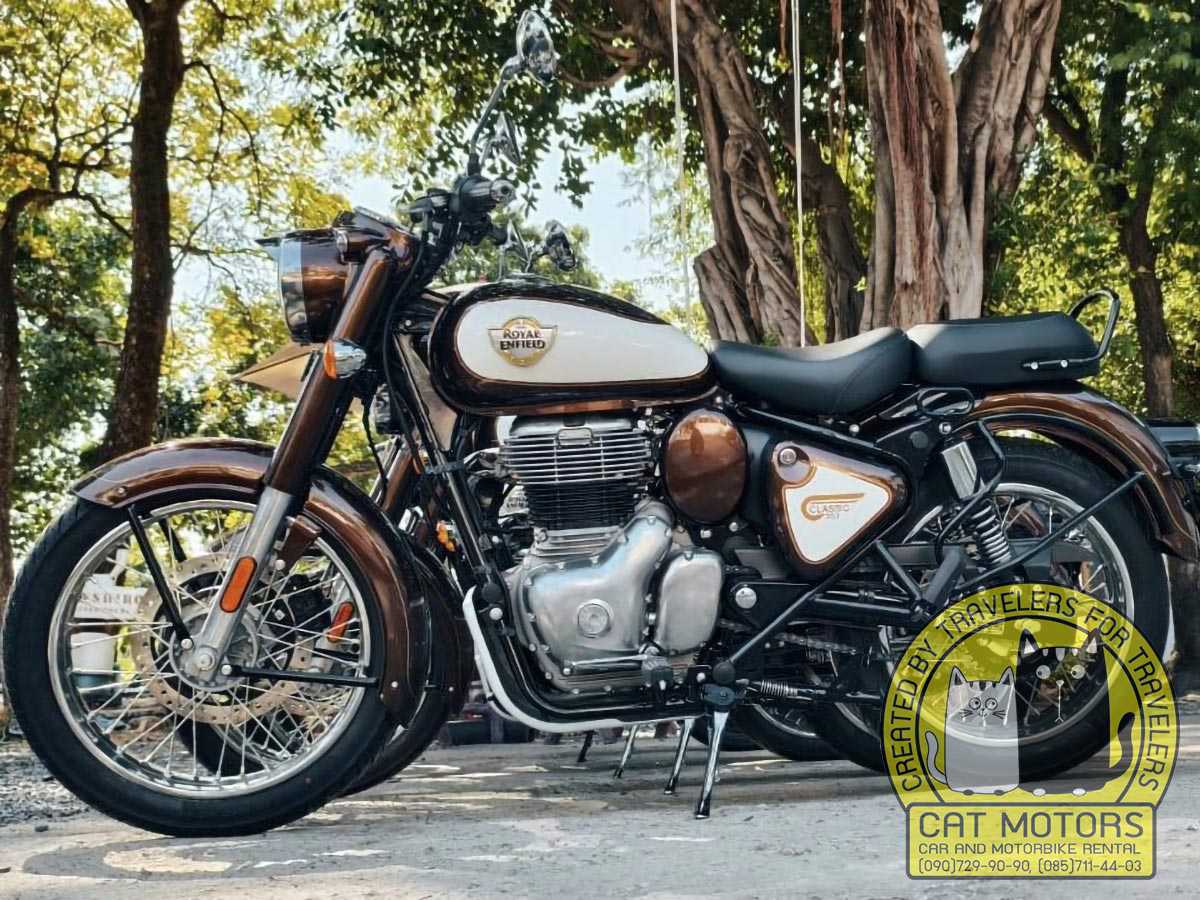
But on the road, weight transforms into virtue. A heavy motorcycle is more stable on rough surfaces; it doesn’t throw you side to side on ruts, doesn’t bounce on every pothole. When the road to Chiang Dao suddenly transitions to patched asphalt with crosswise seams every three meters, a light motorcycle turns into a vibrating platform. Royal Enfield simply swallows these irregularities, dampening vibrations with the mass of the frame and engine. Same thing on gravel sections: a heavy machine holds its line better because it’s harder to knock off course.
Weight also provides psychological comfort. On a narrow serpentine where there’s a several-hundred-meter drop to the right and a cliff to the left, you want to ride something substantial, something that doesn’t feel like a toy in the wind’s hands or under the wheels of a passing truck. Royal Enfield is exactly that. Not fast, but reliable. It moves like a stone rolling down a mountain: slowly but surely.
Riding Position for Long Hauls
The distance from Chiang Mai to Mae Hong Son as the crow flies is about 150 kilometers. By road through Pai, it’s 370 kilometers of serpentine that takes six to seven hours of pure saddle time if you ride calmly and stop to look at the views. During these six hours, how exactly you sit on the motorcycle becomes important.
The Classic 350 has what’s called an “upright” or “neutral” riding position. Handlebars high, footpegs under the rider, back straight. This isn’t a sporty position with forward lean where body weight transfers to the wrists, nor a cruiser position with legs stretched forward where the lower back gets tired. This is the position where you can sit for hours because the load is evenly distributed. Arms rest on the handlebars freely, without tension. Legs bent at a natural angle. The back supports itself without effort.
The seat is wide and soft, designed for prolonged use. The passenger position is also comfortable, with grab rails you can hold onto without clinging to the rider. This matters if you’re traveling with a partner who isn’t used to motorcycles and gets nervous on curves. Royal Enfield gives the passenger the feeling they’re sitting on a couch rather than balancing on the rear fender.
Fuel Consumption and Range
A 13-liter tank. Real consumption when riding through mountains fluctuates between 2.8 and 3.5 liters per hundred kilometers, depending on riding style and road profile. This means a range of about 370-400 kilometers on one tank. Enough to ride from Chiang Mai to Pai, return, and still make a trip to Doi Suthep without stopping for fuel.
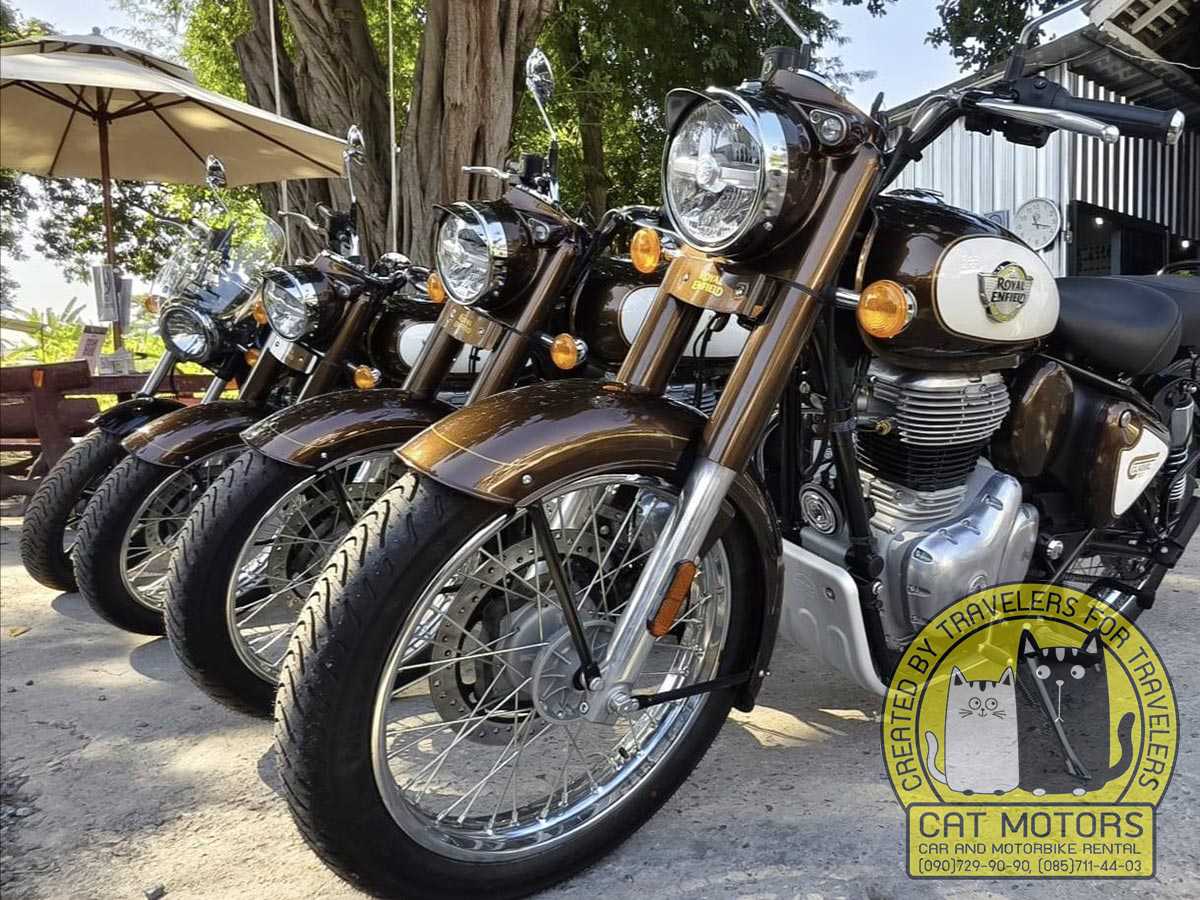
In the northern provinces, gas stations appear less frequently than in central regions. Between Chiang Mai and the Myanmar border on Highway 1095 (Mae Hong Son Loop), there are sections where the next gas station is 80-90 kilometers away. On a motorcycle with a small tank, this forces you to plan your route around gas pumps. Royal Enfield lets you forget about this problem. Fill up in Chiang Mai, ride wherever you wanted, return, and still have enough left for a couple days of city trips.
The engine’s fuel efficiency is related to its design. A long-stroke single-cylinder motor operates at low RPMs where fuel consumption is minimal. No need to maintain 6,000-7,000 RPM to keep up speed. On most roads in Northern Thailand, comfortable cruising speed is 60-80 kilometers per hour, and at this speed the Royal Enfield engine works in its most economical range.
Reliability as a Consequence of Simplicity
The Royal Enfield Classic 350 uses technologies proven over decades. Air cooling, carburetor (in older versions) or simple fuel injection (in newer ones), chain drive, disc brakes front and rear with dual-channel ABS. The electronics are minimal but modern: fuel injection, electronic ignition, and ABS for safety, without complex traction control systems or riding modes. This is a motorcycle that can be fixed in any village workshop with wrenches and an understanding of basic internal combustion engine principles.
In Thailand, where most mechanics grew up on old Honda Dreams and Yamaha Y125ZRs, the Royal Enfield design is intuitively understandable. If something breaks, it can be fixed. If a part is needed, it can be ordered or an analog found. If the motorcycle stalls in the middle of the road to Chiang Rai, a local mechanic will be able to start it without calling a tow truck or sending the machine to an official service center a hundred kilometers away.
This quality is especially valuable for those planning multi-day trips through remote areas. When riding through remote areas of Nan Province toward the border, where the next town can be 60 kilometers away, you want to be confident the motorcycle won’t let you down. And if it does, that repairs won’t turn into an epic saga of parts delivery from Bangkok.
Retro Aesthetics and Practicality 💗💗💗
The Classic 350 looks like a motorcycle from the 1960s. Round headlight, chrome fenders, classic teardrop tank, spoked wheels. This isn’t a random design decision but a conscious reference to an era when motorcycles were created for travel, not for track speed records.
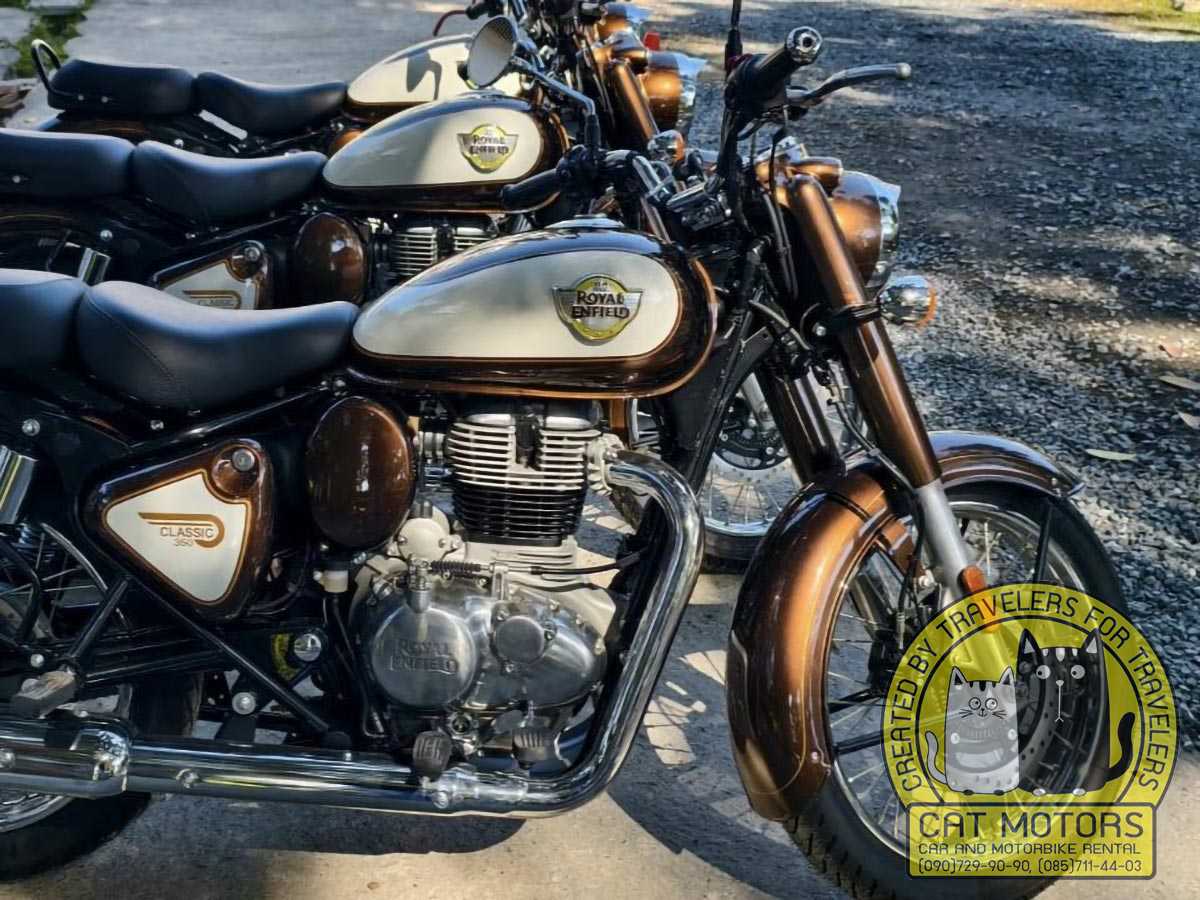
Many renters choose Royal Enfield precisely for its appearance. The motorcycle is photogenic; it looks beautiful against rice fields, mountain serpentines, and Lanna-style temples. For those who keep a blog or simply want to bring back beautiful photos from their trip, this matters. Modern sport bikes all look the same: aggressive plastic fairings, digital instruments, sharp lines. Royal Enfield looks like a character; it has personality.
But behind the retro form hides modern functionality. The engine meets Euro 5 environmental standards, electronics manage fuel injection, ignition is electronic without the whims of a mechanical distributor. The motorcycle starts on the first try, runs smoothly, and doesn’t require constant carburetor adjustment like real 1960s machines. This is stylization, but not a sacrifice of comfort for authenticity.
Which Routes It Suits
The Royal Enfield Classic 350 was created for unhurried travel on roads with varied surfaces and terrain. It’s ideal for the Mae Hong Son Loop, a circular route about 600 kilometers long that passes through Pai, Mae Hong Son, Mae Sariang, and returns to Chiang Mai. The road includes endless serpentines (1,864 turns, if you believe the counter at the entrance to Mae Hong Son), gravel sections, sharp climbs and descents. Royal Enfield completes this route with that monotonous confidence that allows the rider to focus on scenery rather than battling with control.
It’s good for trips to Chiang Rai and beyond, to the Golden Triangle, where the road winds between tea plantations and fog-covered hills. Suitable for journeys east to Nan Province, where asphalt alternates with sections where road crews are working and you have to detour repair equipment along the shoulder. Handles the road to Doi Inthanon, Thailand’s highest point, where the climb lasts more than an hour and it’s important that the motorcycle doesn’t overheat or lose pulling power at altitude.
Royal Enfield doesn’t suit those who want to quickly get from point A to point B on a fast highway. It’s not built for racing and overtaking. Maximum speed is about 120 kilometers per hour, and at this speed the motorcycle starts vibrating, making it clear it’s more comfortable at 70-80. But in Northern Thailand there’s rarely opportunity to go faster. Roads are narrow, turns frequent, trucks slow, tourist buses even slower. Royal Enfield moves at the same pace as surrounding traffic, and this isn’t a flaw but correspondence to conditions.
What You Need to Know Before Renting
Royal Enfield is heavier than most motorcycles available for rent. If your riding experience is limited to light scooters or motorcycles up to 150 cubic centimeters, it will take time to get used to the weight. In parking lots, when maneuvering at low speed, when making a U-turn on a narrow road, the mass is felt. You need to be able to maintain balance and understand that the motorcycle won’t stop instantly if it decides to fall. This isn’t difficult, but requires basic skills in handling a large machine.
The single-cylinder engine vibrates. This is normal for such a design. Vibrations transmit to the handlebars and footpegs, especially at mid and high RPMs. Some riders like this; they consider vibrations part of the motorcycle’s character. Others find it bothersome, especially on long rides when after several hours your hands go numb. Gloves with gel inserts help, but vibrations don’t disappear. Worth considering if you plan to spend more than four to five hours daily in the saddle.
The motorcycle isn’t designed for carrying large amounts of luggage. You can strap a backpack on the rear, you can hang side bags, but it’s important to remember that the center of gravity will rise and handling will change. Royal Enfield is stable, but excess weight at height makes it less maneuverable. For traveling light it’s ideal. For trips with a tent, sleeping bag, and full camping gear, think twice.
Rental Price and Conditions
The rental cost of a Royal Enfield Classic 350 at Cat Motors is higher than standard motorcycles with 125-150 cubic centimeter displacement, but lower than large touring motorcycles like Honda NX500. Exact prices depend on season and rental duration. Long-term rental for a week or month works out cheaper per day than short-term rental for two or three days.
Renter requirements are standard: category A or A2 license, age over 21, deposit in cash or card hold. Before issuing the motorcycle, an inspection is conducted, all scratches and damage are documented, handling features are explained. This takes 10-15 minutes but helps avoid misunderstandings upon return.
Cat Motors has been operating in Chiang Mai since 2010, specializing in Northern Thailand travel. The office is located in a convenient spot with free parking where you can leave personal transport during your trip. Staff speak English and Thai, help with route planning, recommend accommodation, and warn about challenging road sections.
Why Now
Cat Motors’ decision to add Royal Enfield Classic 350 to the rental fleet is connected to growing interest in slow travel. Tourists increasingly choose not a quick scroll through attractions in three days but unhurried exploration of a region over a week or two. They need a motorcycle that doesn’t tire, doesn’t require constant attention, and allows focusing on the road and surrounding world rather than battling with control.
Northern Thailand is becoming more popular among experienced motorcyclists who have already ridden through Vietnam, Cambodia, Laos and are looking for new routes. These people understand the difference between motorcycles and want a machine that matches their travel style. Royal Enfield answers their requests: reliability, character, comfort for long hauls, ability to handle any roads.
Quick Reference
Model: Royal Enfield Classic 350
Engine displacement: 349 cc
Brakes: 300mm front disc, 270mm rear disc, dual-channel ABS
Power: 20.2 kW (27 hp) at 5,250 RPM
Torque: 27 Nm at 4,000 RPM
Weight: 195 kg (with full tank)
Tank capacity: 13 liters
Fuel consumption: 2.8-3.5 l/100 km
Range: 370-400 km
Riding position: neutral (upright)
Cooling: air-cooled
Transmission: 5-speed manual
Where to rent: Cat Motors Motorbike Rental, Chiang Mai
Availability: from January 2026
Booking: via website, phone, or WhatsApp
Recommendation: book in advance during high season (November-February)
Motorcycles undergo full technical service before each rental. Cat Motors provides roadside support in case of technical problems and can arrange motorcycle evacuation for serious breakdowns.