
Baan Dam Museum is worth visiting, but only if you arrive with one piece of knowledge that most visitors lack. The compound of 40-plus buildings in Chiang Rai, built by National Artist Thawan Duchanee over nearly four decades, rewards preparation and punishes the casual drop-in. Without understanding why buffalo skulls sit on the same shelf as lacquered Buddhas, you will see a dark curiosity. With it, you will see one of the most deliberate artistic statements in Southeast Asia.
That one piece of knowledge is Amsterdam. Thawan spent six years at the Rijksakademie van Beeldende Kunsten, studying Dutch and Flemish masters who saw no contradiction between the holy and the grotesque. Everything at Baan Dam follows from this. The closed buildings, the absent labels, the bones on every surface: these are not flaws in the experience. They are the experience.
Contents
show
Riders who picked up a motorbike rental in Chiang Mai have the best of it: Route 118 north runs 200 kilometers through mountain roads before the highway flattens into Chiang Rai, and Baan Dam sits 13 kilometers beyond the city on a straight, well-paved Route 1. The day pairs naturally with the White Temple and the Blue Temple. Three sites, one line of travel, the full range of what contemporary northern Thai art looks like. Baan Dam is the one that stays with you.
Why Baan Dam Looks the Way It Does
Before Thawan Duchanee arrived at the Rijksakademie van Beeldende Kunsten in 1963, he had already earned criticism from the man who built modern Thai art education. Silpa Bhirasri, the Italian sculptor who founded Silpakorn University, looked at the young painter’s early work and called it “a fish without smell.” The technical skill was present. The identity was not.
Amsterdam supplied the identity. Thawan completed his master’s degree and doctoral research at the Rijksakademie between 1963 and 1969, and the paintings that changed his direction were not Thai. They were Brueghel’s village feasts where a skeleton dances among the living. They were Rembrandt’s slaughtered ox hanging in a doorway, still life and death in the same frame. The Dutch and Flemish tradition of the 16th and 17th centuries placed the sacred beside the grotesque without announcing the contradiction. An angel and a rotting carcass occupied the same canvas with equal weight.
Thawan returned to Thailand and translated this grammar into different materials. Where Brueghel used oil paint, Thawan used teak, bone, lacquer, and hide. A buffalo skull on a carved wooden shelf next to a gilded Buddha is not provocation. It is the same visual logic that places a Madonna beside a butcher’s table in a Flemish altarpiece. The materials changed. The principle did not.
He explained his own method directly: “I need to see fangs, tusks, claws, talons, skins of carnivores because the sense of taste, touch, smell, sight, and sound sharpen my imagination.” The bones were not decoration or symbol. They were tools of sensory concentration, the raw material that kept his attention sharp enough to paint.

Thawan’s drawing technique was itself physical. He worked with ballpoint pen on paper for his engravings, pressing the point into the surface until it left grooves, each mark cut into the sheet with a force that made it irreversible.
The path from Amsterdam to Baan Dam was not smooth. In 1971, eighty students armed with metal rulers vandalized his exhibition at Silpakorn University, slashing canvases in what they called a moral protest against the violence and sexuality in his work. The attack did not soften his approach. It confirmed his suspicion that public exhibition spaces were hostile territory, places where an audience believed it had the right to edit what it saw.
Two years later, in 1973, the writer and politician Kukrit Pramoj organized Thawan’s solo show at the British Council in Bangkok, placing the work under institutional protection. Kukrit’s endorsement gave Thawan credibility with Thailand’s cultural establishment. More importantly, it gave him permission to stop performing for galleries entirely.
By 1975, Thawan had begun construction on his own compound in Chiang Rai, on family land in Tambon Nang Lae. At 37, he built his own coffin and placed it on the grounds, not as morbidity but as a statement of position. Death was present. It had always been present in the Dutch paintings he studied, in the skull beside the Bible on a Leiden professor’s desk. Thawan simply removed the metaphor and made the coffin physical.
Before You Go: What Most Visitors Get Wrong

The most common mistake is arriving on a Monday. Baan Dam is closed every Monday and on official Thai holidays, a fact confirmed by the government museum database at SAC.or.th and directly contradicted by most English-language guides that write “open daily.” If your Chiang Rai schedule only has one day, check the calendar before committing it to Baan Dam.
The second mistake is expecting an interactive museum. Most of the 40-plus buildings are closed to visitors. You cannot enter them. This is not poor management. It was Thawan’s own philosophy: Baan Dam was designed as an object of observation from the outside, not a route through the inside. He did not want visitors handling the objects or standing inside the spaces he built for his own work. The same logic explains why there are no English-language explanatory signs anywhere on the grounds. Thawan did not believe in placing a mediator between the viewer and the space. You look, or you don’t.
Visitors who arrive expecting labels, audio guides, or a curated path through gallery rooms will be frustrated. Those who arrive understanding that the closed doors are the point will see the compound differently.
A third practical issue: a midday break occurs around 12:00 to 13:00, during which parts of the grounds may be less accessible or staff unavailable. Arriving before 11:30 or after 13:00 avoids this.

One more consideration. Baan Dam contains phallic sculptures, animal bones, crocodile skins, and imagery that deals with death and sexuality without softening. Inside the buildings that do allow partial viewing, you may see an elephant skeleton positioned alongside buffalo skulls, a long wooden dining table surrounded by black chairs, and surfaces covered in animal hides. The scale of the collection is not decorative. Every surface carries something: bone, hide, horn, tooth. If this subject matter is uncomfortable for you, Baan Dam will not become comfortable midway through.
The Architecture: Three Languages in One Compound
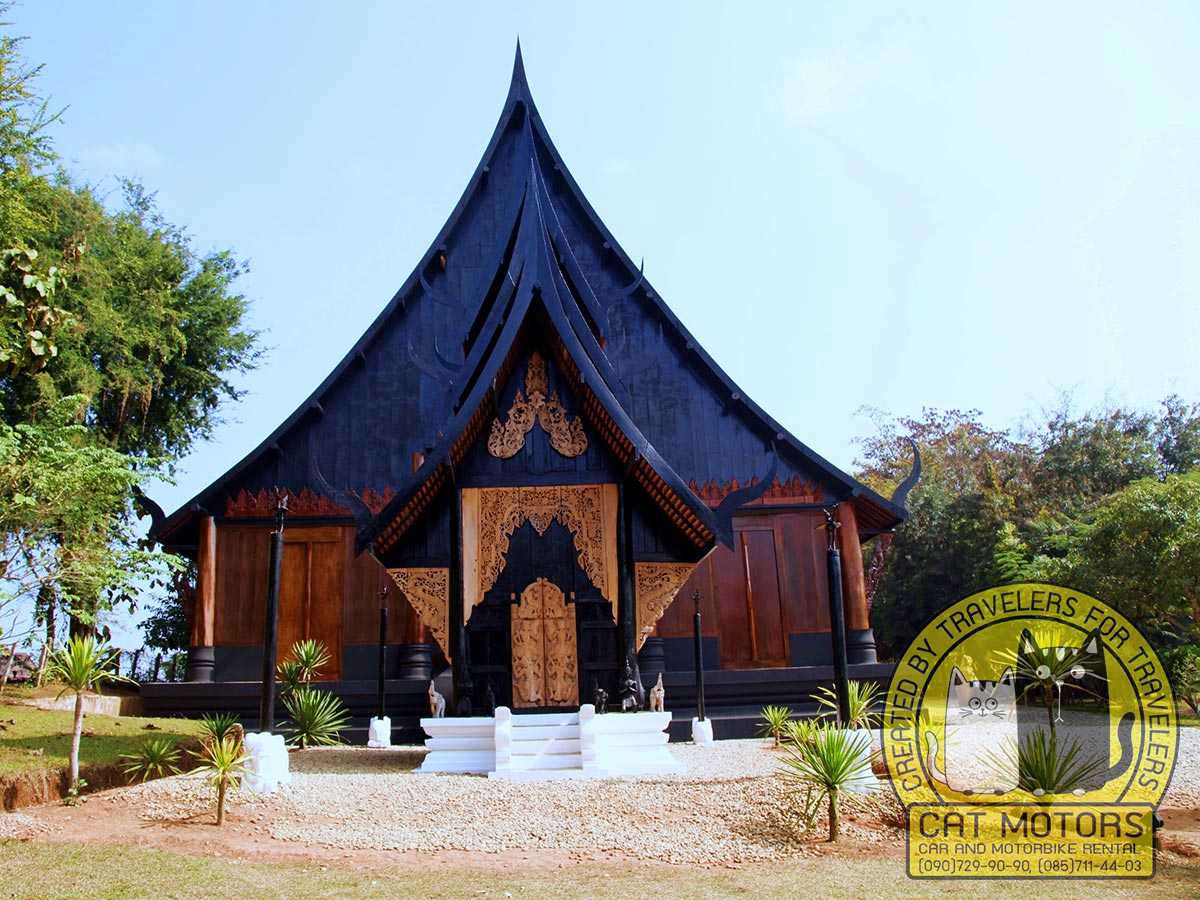
Most guides describe Baan Dam’s buildings as “dark wood.” This is like describing the Sistine Chapel as “a ceiling with paint.” The compound follows a documented architectural system that draws from three distinct regional traditions, identified in the Chiang Rai municipal cultural record as the structural framework for the entire site.

The first is Lan Chang, the tradition of the Mekong River basin. Its visible signature at Baan Dam is the elongated eave sweep, often terminating in a curved swan’s tail finial (หางหงส์), a low, extended roofline that reaches outward rather than upward. Buildings with Lan Chang influence sit close to the ground and project horizontally, their eaves creating deep shadow beneath.
The second is Lanna, the tradition of Northern Thailand. Lanna buildings at Baan Dam are recognizable by steep teak gables, dark and sharply angled, sometimes approaching a mansard profile. The wood is dense, the joins tight, and the overall effect is vertical compression: the building appears to be pressing downward into its foundation.
The third is Suvarnabhumi, the broader Indic-Buddhist tradition of mainland Southeast Asia. Its marker at Baan Dam is the threshold animal form: serpent carvings, guardian figures, and creature sculptures placed at doorways and entrances.
Each building in the compound reads as a different combination of these three languages. The system is deliberate, not decorative.

Tri Phum, the first building constructed in 1976 to 1977, sits on a triangular plan. It collapsed during construction. Thawan rebuilt it. It collapsed again. He rebuilt it again. It collapsed a third time. He rebuilt it a third time. The building that stands today is the result of that stubbornness, and it sets the tone for everything that follows: Baan Dam was not inspired. It was insisted upon.
The East Pavilion, built in 1994, combines floor-to-ceiling glass with a Lanna mansard roofline, placing a fully visible interior inside a traditional silhouette. It is the clearest example of Thawan working across periods within a single structure.
At the far end of the compound stands the Maha Wiharn, the Cathedral. Thawan began constructing it in 1999 and worked on it for ten years, completing the structure by 2009. The building rises on a brick base of 2.8 meters. Forty-four wooden pillars support a four-tier roof that combines Lanna proportions with a scale that belongs to something institutional. It is the largest and final major building on the grounds. Thawan died in 2014. The Cathedral was his last architectural statement, and its decade of construction makes the timeline visible: this was not a project that happened quickly or easily.
Many of the roofs across the compound use unglazed clay tiles, a material choice that darkens naturally with age and rain, deepening the visual weight of each building over decades.

The compound also includes the Shan Pavilion, the Golden Tower, the Lao House, and Wiharn Raam, smaller buildings that demonstrate regional variations within the same three-language system. There are igloo-shaped white domes, a whale-shaped building that stretches a Lan Chang roofline to its horizontal limit, a hornbill-shaped building that takes a Suvarnabhumi threshold form and scales it to the size of a pavilion. Each building tests a different combination of the same three languages.
While the compound was rising in Chiang Rai, Thawan was painting on another continent. Between 1977 and 1980, he spent three years on the interior of Gottorf Castle in northern Germany for Count Hermann Hatzfeldt.
How to Move Through It

The compound rewards chronological movement. Start at Tri Phum, the triangular building near the entrance, built in 1976 to 1977. This was the beginning, and its scale and simplicity make sense as a starting point. From there, move through the smaller buildings: the Lao House, the Shan Pavilion, the Golden Tower, the Small Temple (วิหารเล็ก, built 1992), and the Woodcarving Workshop (โรงแกะไม้), paying attention to how the rooflines shift between Lan Chang, Lanna, and Suvarnabhumi signatures as you walk.
Between structures, gravel paths cut through mowed grass and mature rain trees. The compound covers 160,000 square meters, and the walks between buildings take two to five minutes each. These intervals are not empty. They are the silence between sentences.
End at the Maha Wiharn. If you have followed the chronology, you will arrive at the Cathedral understanding that it took ten years to build, that it was the final word of an artist who started with a triangle that fell down three times. The building earns its weight through everything that precedes it.
Allow a minimum of one and a half to two hours. Less than that, and you will rush through the smaller buildings, which contain the details that make the Cathedral legible.
The Baan Dam Gallery, a separate building near the entrance, opens at 08:00 and closes at 17:30. It operates on different hours from the main museum grounds, which open at 09:00. If you arrive early, the Gallery is accessible before the compound opens.
Baan Dam and White Temple: The Right Comparison

Every guide to Chiang Rai places Baan Dam and the White Temple (Wat Rong Khun) in the same sentence. The framing is always “darkness versus light” or “hell versus heaven.” This comparison is satisfying and wrong.
Chalermchai Kositpipat, who built the White Temple, was Thawan’s contemporary in Chiang Rai. Both were trained at Silpakorn University. Both chose to build rather than exhibit. But their programs diverge completely.
The White Temple is a religious space with a religious function. Chalermchai designed it as an active Buddhist project: the murals inside depict suffering and redemption, the white exterior represents purity, and the entire structure is open to visitors because openness is the point. It teaches.
Baan Dam is a biographical space with an artistic function. Thawan designed it as a private compound that happens to admit visitors. The buildings are closed because closure is the method. The bones and hides are present because they sharpen the maker’s senses, not because they symbolize evil. It does not teach. It presents.
The question is not which is better. It is which kind of encounter you want: a guided spiritual experience, or a confrontation with one artist’s unmediated logic.
If you visit both in a day, the contrast between them becomes richer. Baan Dam opens at 09:00. Arrive by 09:15, spend until 11:30, return to Chiang Rai city for lunch, then visit the White Temple after 13:00. The two sites are about twenty minutes apart by car.
Baan Dam is now managed by Doythibet Duchanee, Thawan’s son, who studied at RILCA, Mahidol University. The compound continues to function as both a memorial and a working artistic space.
Practical Information

Baan Dam Museum sits in Tambon Nang Lae, roughly 13 kilometers north of central Chiang Rai. By Grab or private car, the drive takes 20 to 25 minutes. By songthaew, allow 30 to 40 minutes.
Admission is 80 THB.
Opening hours are Tuesday through Sunday, 09:00 to 17:00. The museum is closed every Monday and on official Thai holidays. The Baan Dam Gallery near the entrance operates separately, from 08:00 to 17:30.
There is no formal dress code, though modest clothing is appropriate given the cultural setting.
Thawan Duchanee was named National Artist of Thailand in Visual Arts in 2001. His work has been collected internationally: the Fukuoka Asian Art Museum in Japan holds “Worship” (1964). In 2023, Christie’s auctioned “Scream of Sorrowful” for 26.6 million baht.
The bones, the closed doors, the absent labels: what looks like an obstacle is the work itself. Knowing why changes what you see.


